JOINTED CLAW 178
鮎邪 JOINTED CLAW 178
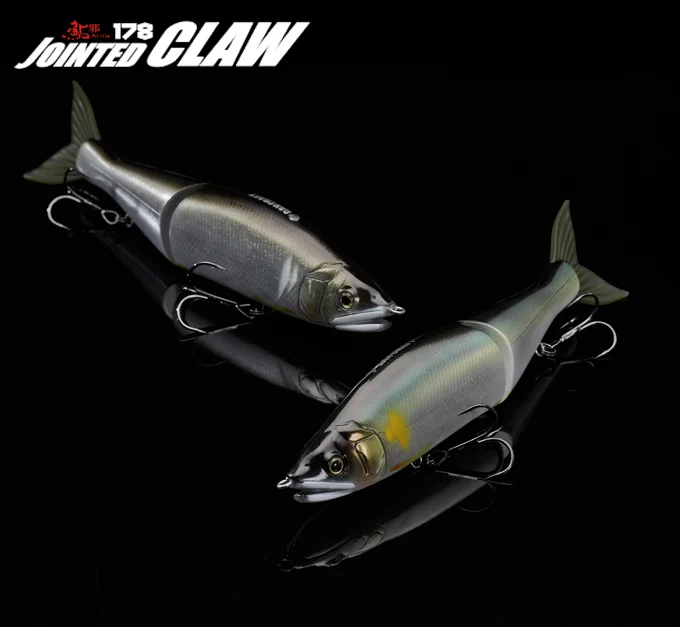
A landmark 178 mm jointed glide bait from GAN CRAFT that helped establish the S-shaped swimming style in Japanese big-bait fishing. The lipless JOINTED CLAW 178 produces a wide, natural S-curve during a simple steady retrieve and is available in both Floating and Slow Sinking versions.
What is the JOINTED CLAW 178?
The JOINTED CLAW 178 is a 178 mm jointed big bait from GAN CRAFT and one of the defining lures of Japan's S-shaped swimming style.
Unlike conventional hard baits that use a diving lip to create wobbling or rolling action, the JOINTED CLAW is lipless.
Its jointed body and balance allow the lure to travel through the water in a wide S-shaped path during a simple steady retrieve.
This swimming action became the defining characteristic of what Japanese anglers commonly call "S-ji-kei," or S-shaped lures.
The original 178 model weighs approximately 2 oz class and is available in both Floating and Slow Sinking versions, allowing anglers to adapt the same basic swimming concept to different depths and situations.
Why it's popular in Japan
The JOINTED CLAW 178 is important not simply because of its size, but because of the swimming concept it helped establish.
GAN CRAFT describes the lure as the origin of the S-shaped swimming style.
Instead of relying on rapid vibration or aggressive body movement, the JOINTED CLAW moves through the water with a broad side-to-side path that gives the lure the appearance of a large swimming prey fish.
The 178 mm size also helped establish a practical middle ground for Japanese big-bait fishing: large enough to create a strong visual presence, but still manageable as a lure that can be repeatedly cast and retrieved.
Its influence can be seen in the many S-shaped jointed and glide-style baits that later became an established part of Japanese bass fishing.
How Japanese anglers fish it
The most fundamental way to fish the JOINTED CLAW 178 is with a steady retrieve.
As the lure is reeled through the water, its jointed lipless body produces the wide S-shaped swimming path that defines the lure.
Retrieve speed can be changed to alter the pace and character of the presentation, while the Floating and Slow Sinking versions allow anglers to approach different depths.
Rod movement and changes in line tension can also be used to interrupt the regular swimming path and create sudden changes in direction.
These changes can be particularly useful when a bass follows the lure without immediately striking.
Because the lure creates much of its characteristic action through its body design and balance, anglers can fish it effectively with relatively simple input while still experimenting with speed, pauses, and directional changes.
Recommended situations
- Big-bait and glide-bait fishing
- Steady retrieves
- Targeting larger bass
- Baitfish and ayu-oriented fisheries
- Clear to moderately stained water
- Situations where visual drawing power is important
- Fishing around points, flats, cover edges, and other ambush areas
- Following fish that may respond to changes in retrieve speed or direction
- Situations where a conventional vibrating lure produces too much repetitive action
How it differs from US-market lures
US anglers will recognize the JOINTED CLAW 178 as a glide bait, but the lure is historically important for the development of the Japanese "S-shaped" big-bait concept.
Rather than using a diving lip to generate conventional wobbling or rolling action, the JOINTED CLAW uses its jointed, lipless body to travel in a broad S-shaped path during the retrieve.
This places the emphasis on the path of the entire lure rather than rapid vibration from the body.
The concept is simple: a large jointed lure, a controlled retrieve, and a wide swimming trajectory that presents the lure as a substantial moving prey item.
For anglers exploring JDM bass fishing, the JOINTED CLAW 178 is an important reference point for understanding how Japanese S-shaped big-bait fishing developed into a distinct lure category.