WILD HUNCH
ワイルドハンチ
A legendary Japanese shallow-running crankbait developed by Morizo Shimizu. The WILD HUNCH combines stable high-speed swimming, strong cover deflection, and a bite-triggering wobble-and-roll action in a compact 52 mm body.

What is the WILD HUNCH?
The WILD HUNCH is a shallow-running crankbait developed by Japanese professional angler Morizo Shimizu for EVERGREEN's Mo-DO lineup.
At 52 mm and 9.6 g, it is a compact floating crankbait designed to run approximately 1.2–1.6 meters deep.
One of Shimizu's primary requirements was simple but demanding: the lure had to continue swimming properly even with relatively heavy line and at high retrieve speeds. That philosophy was shaped in part by his experience competing in American bass tournaments, where a crankbait may need to be cast and retrieved repeatedly around demanding shallow cover.
Its 3D Hyper Lip is designed to combine wobbling and rolling action while maintaining strong contact with the water. The lip and body also help the lure deflect around hard cover such as timber and riprap.
Internally, the WILD HUNCH uses fixed tungsten weights positioned low in the body rather than a moving-weight casting system. This creates a stable center of gravity while allowing the lure's body and lip to generate its characteristic action.
The result is a crankbait designed to be cast, retrieved, and trusted repeatedly—a concept that has made the WILD HUNCH one of EVERGREEN's best-known crankbaits.
Why it's popular in Japan
The WILD HUNCH has become a long-running standard in Japanese crankbait fishing because it combines a compact profile with the durability and stability needed for aggressive power fishing.
Morizo Shimizu developed the lure around the idea that a tournament crankbait must continue swimming correctly under demanding conditions. Heavy line, fast retrieves, repeated casting, and contact with cover were treated as fundamental requirements rather than secondary considerations.
At the same time, the WILD HUNCH was designed to trigger bites during a simple steady retrieve. Its 3D Hyper Lip combines wobbling and rolling movement while also helping the lure deflect around timber, riprap, and other hard structure.
This combination makes the lure useful in Japanese reservoirs, rivers, lakes, and shore-fishing situations where anglers need to cover water efficiently while still fishing around structure.
Its history also connects Japanese and American bass fishing. Shimizu developed his approach while competing extensively in the United States, and the WILD HUNCH itself contributed to a third-place FLW finish during his American tournament career.
How Japanese anglers fish it
The fundamental way to fish the WILD HUNCH is extremely simple: cast it and retrieve it steadily.
Its 1.2–1.6 meter running depth makes it particularly useful for shallow to mid-shallow water. Anglers can adjust retrieve speed and casting angle to keep the lure around the desired depth and structure.
In open water, a steady retrieve allows the lure's built-in wobbling and rolling action to work without additional rod movement.
Around timber, riprap, and other hard cover, the lure can be intentionally brought into contact with structure. Its lip and buoyant body help it deflect away from obstacles, and these sudden changes in direction can trigger reaction bites.
The WILD HUNCH is also designed to remain stable during faster retrieves, allowing anglers to increase speed when searching for active bass.
Although pauses and speed changes can be added, the lure's central concept remains straightforward: keep casting and keep winding, trusting the crankbait itself to create the action.
Recommended situations
- Shallow to mid-shallow water
- Timber and wood cover
- Riprap
- Hard structure
- Reservoirs
- Rivers and natural lakes
- Cover cranking
- Fast searching presentations
- Steady retrieves
- Reaction bites
- When using relatively heavy line
- Water around 1.2–1.6 meters deep
How it differs from US-market lures
The WILD HUNCH is an interesting example of Japanese and American bass-fishing ideas influencing each other.
It was developed by Japanese professional angler Morizo Shimizu, but many of its core requirements were shaped through his experience competing in demanding American bass tournaments.
Rather than focusing primarily on finesse or delicate action, the WILD HUNCH was designed as a compact crankbait that could be cast repeatedly, retrieved quickly, fished with relatively heavy line, and driven through shallow cover while maintaining stable swimming action.
At the same time, its compact 52 mm body, low fixed tungsten weighting, and carefully tuned combination of wobble and roll reflect the detailed engineering associated with Japanese hard-bait design.
For US anglers, the WILD HUNCH is therefore less about a Japanese alternative to American power cranking and more about a crossover: American tournament-style power fishing refined through Japanese lure design.
Video
Related lures
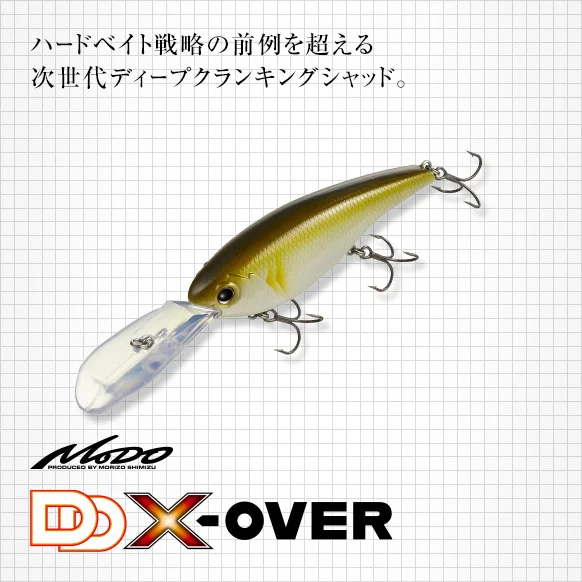
DD X-OVER
DDエックスオーバー
A 100 mm deep-diving crankbait developed by Morizo Shimizu for fishing from shallow bottom structure to suspended bass in deep open water. The DD X-OVER reaches 4.5–5.5 meters while combining long casting, relatively light retrieve resistance, and a natural shad-like swimming action.

Last Ace F
ラストエースF
A floating elastomer soft bait from EVERGREEN designed to imitate a vulnerable baitfish at or near the surface. Available in 80, 95, and 110 mm sizes, Last Ace F supports subtle I-shaped retrieves, surface twitching, and nail-weighted hover strolling presentations.

Lucy
ルーシー
A 3.2-inch Japanese finesse worm designed to help anglers simply catch a bass. Developed by Lake Biwa guide Kenta Onishi, Lucy combines a slim profile with a responsive curly tail and is especially effective on a down shot rig.