Jack Hammer
ジャックハンマー
A tournament-proven bladed jig developed by EVERGREEN with Morizo Shimizu and Brett Hite. The Jack Hammer combines immediate startup, strong high-pitch vibration, stable tracking, and controlled erratic movement—and went on to become one of the most influential Japanese-designed bass lures in the US.

What is the Jack Hammer?
The EVERGREEN Jack Hammer is a premium bladed jig developed from the tournament experience of Japanese professional angler Morizo Shimizu and American bladed-jig specialist Brett Hite.
Its defining characteristic is the combination of strong vibration and control. A thin 0.4 mm stainless-steel blade starts working quickly, while the low-center-of-gravity, flat-bottom head helps the lure track consistently and recover rapidly after deflecting or darting.
Despite producing a pronounced vibration that can be clearly felt through the rod, the Jack Hammer is designed to maintain relatively light retrieve resistance. It can work at slow speeds while remaining stable during faster retrieves.
The head, blade, hook, skirt, snap and trailer keeper were all refined as parts of the same system rather than treated as separate components.
Why it's popular in Japan
The Jack Hammer was developed through tournament fishing rather than simply as a variation of an existing bladed jig.
Morizo Shimizu had been fishing bladed jigs in top-level competition for more than a decade, testing numerous designs and accumulating extensive experience with what worked and what needed improvement. Development of the Jack Hammer began in 2014 together with Brett Hite, whose success with bladed jigs in major US tournaments brought another perspective to the project.
Prototypes were then tested and refined in competition, including Bassmaster Elite Series events, before the production lure was released in 2017.
For Japanese anglers, its appeal lies in its versatility: it can be retrieved steadily through open water and vegetation, skipped beneath cover, or deliberately made to break from its stable tracking to trigger a reaction bite.
How Japanese anglers fish it
A steady retrieve is the foundation of Jack Hammer fishing. Choose the weight according to the depth you want to cover and adjust retrieve speed to keep the lure around vegetation, cover, or the depth where bass are holding.
EVERGREEN recommends approximately 0.3–1 m for the 3/8 oz model, 1–2 m for 1/2 oz, 2–3.5 m for 3/4 oz, and 3.5–6 m for the 1.2 oz model, although actual running depth varies with line, trailer and retrieve speed.
It can also be accelerated momentarily to make the lure break from its stable path and produce an erratic dart. When it contacts cover or the bottom, allowing it to deflect before resuming the retrieve can create another reaction opportunity.
Its flat head also makes the Jack Hammer particularly useful for skipping underneath overhanging cover.
Recommended situations
- Around submerged grass and weed edges
- Flats and open-water baitfish areas
- Around docks and overhanging cover
- When bass respond to vibration and reaction presentations
- Slow rolling in deeper water
- Fast retrieves for active fish
- Deflecting off cover or bottom structure
- Tournament situations where covering water efficiently is important
How it differs from US-market lures
This section is particularly interesting because the Jack Hammer is no longer simply an alternative to US-market bladed jigs—it became part of the US market itself.
The lure combines Japanese refinement with direct input from American tournament fishing. Morizo Shimizu brought years of experience testing bladed jigs in competition, while Brett Hite contributed ideas developed through his exceptional success with the category in the United States.
Its thin blade, low-center-of-gravity head, quick startup, strong but manageable vibration, stable tracking and rapid recovery were refined as an integrated system.
The result crossed back into the United States, where it is now officially sold by Z-Man as the ChatterBait JackHammer and has become a major tournament-proven lure in its own right.
Rather than showing how a JDM lure differs from American lures, the Jack Hammer is a particularly good example of Japanese and American bass-fishing ideas influencing each other.
Video
Related lures
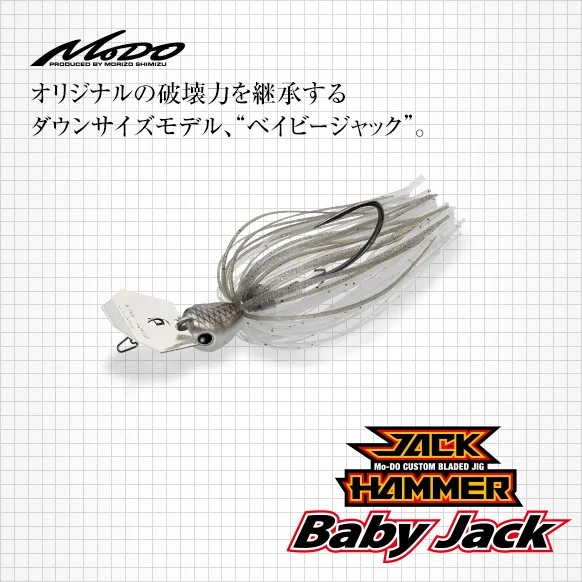
Jack Hammer Baby Jack
ジャックハンマー ベイビージャック
A downsized version of the EVERGREEN Jack Hammer developed by Morizo Shimizu and Brett Hite. The Baby Jack combines a compact profile with tight, high-pitch vibration, excellent casting distance, and strong high-speed stability for pressured bass and smaller baitfish situations.

Last Ace F
ラストエースF
A floating elastomer soft bait from EVERGREEN designed to imitate a vulnerable baitfish at or near the surface. Available in 80, 95, and 110 mm sizes, Last Ace F supports subtle I-shaped retrieves, surface twitching, and nail-weighted hover strolling presentations.

Lucy
ルーシー
A 3.2-inch Japanese finesse worm designed to help anglers simply catch a bass. Developed by Lake Biwa guide Kenta Onishi, Lucy combines a slim profile with a responsive curly tail and is especially effective on a down shot rig.